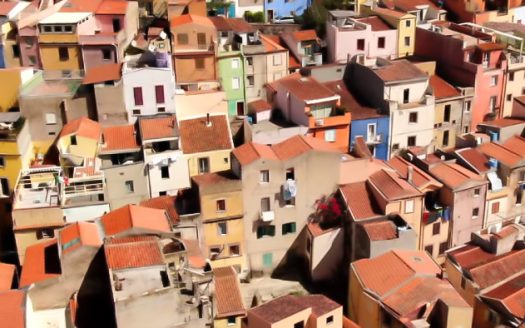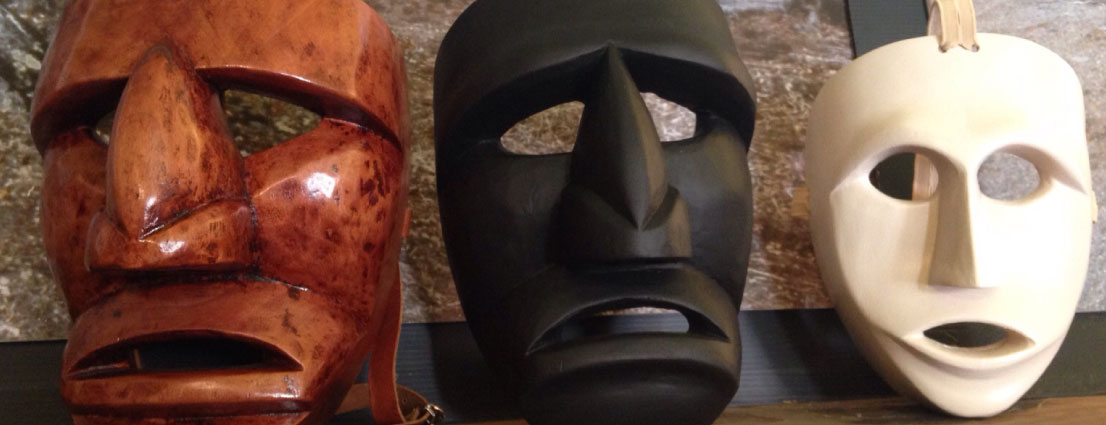
The Carnival of Mamoiada, the Mamuthones and Issohadores masks
The Mamoiada Carnival is one of Sardinia’s most famous and evocative traditional celebrations, an ancient ritual that still preserves its unique charm and powerful symbolism.
Mamuthones and Issohadores, the traditional masks of Mamoiada are the undisputed protagonists of the Carnival. They first appear during the Feast of Saint Anthony the Abbot, between January 16 and 17. The ritual is then repeated on Carnival Sunday and Shrove Tuesday.
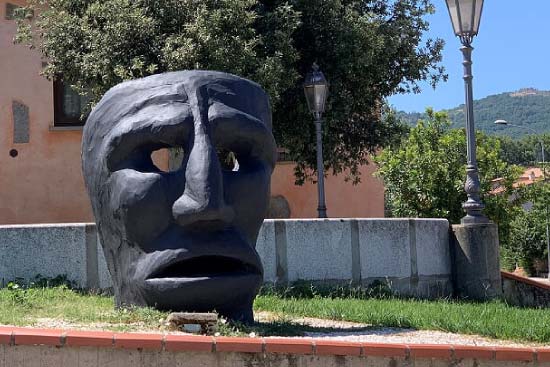
The origins of this ancient ritual, also known as the “Dance of the Mamuthones,” remain shrouded in mystery. Despite the many theories put forward over the years, none has been definitively proven.
From an anthropological perspective, the Mamoiada Carnival is associated with ancient rituals of death and rebirth in nature, as well as with the deep relationship between humans and animals.
These masks were traditionally believed to possess propitiatory powers, with their presence thought to bring a good harvest and protect livestock. For this reason, despite their imposing and somewhat mysterious appearance, the Mamuthones and Issohadores were welcomed with respect and offered food and drink.
The entire community takes part in preparing the masks, highlighting the importance of the celebration and the commitment to preserving this ancient Sardinian tradition.
Mamuthone: Costume, Mask and Bells
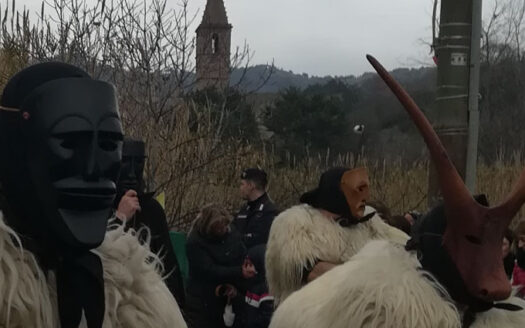
The Mamuthones of Mamoiada wear the traditional mastruca, a white or black sheepskin garment known as sas peddhes, over a velvet or fustian outfit called su belledu.
Their faces are concealed by a black wooden mask (sa bisera), traditionally carved from alder or wild pear wood. With its solemn, impassive expression and pronounced features, the mask gives the Mamuthone its distinctive and striking appearance. On their heads, they wear su bonette, a traditional male cap partially covered by su muncadore, a black or dark-red women’s headscarf.
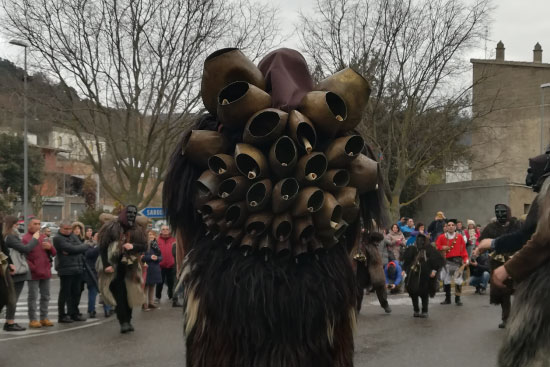
The most distinctive element of the Mamuthone costume is sa carriga, the set of large bells worn on the back and fastened with sturdy leather straps. They can weigh up to 30 kilograms in total. In the past, local shepherds provided these bells, known as sonazzos, often donating worn bells or even those taken directly from their animals.
Every movement of the Mamuthones is accompanied by the rhythmic sound of the bells, creating the unmistakable soundscape of the Mamoiada Carnival and one of the most evocative expressions of Sardinian folk tradition.
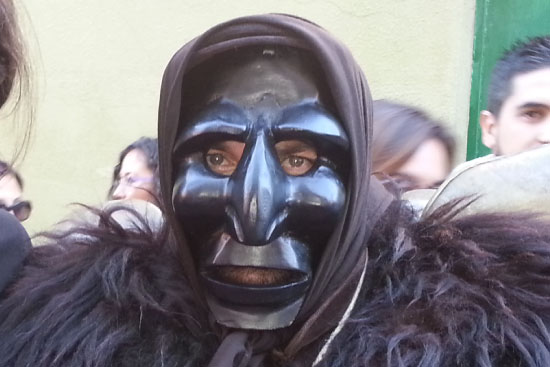
Issohadore: Costume and Mask
The Issohadore is the complementary mask to the Mamuthone and, together with it, is one of the main protagonists of the Mamoiada Carnival.
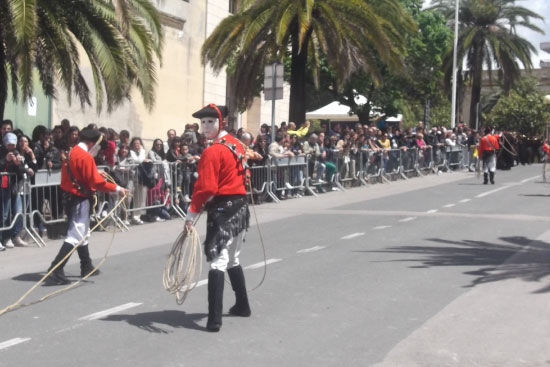
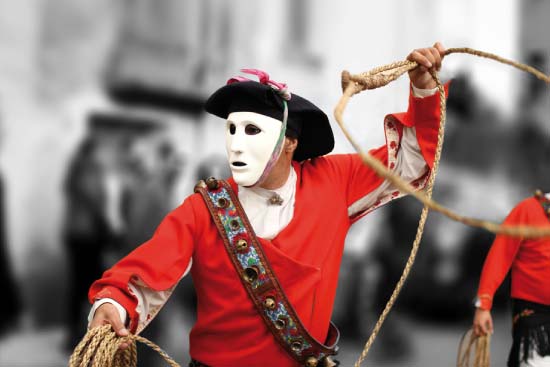
His traditional outfit, known as “veste’e turcu” (“Turkish dress”) by the elders of Mamoiada, includes a black Sardinian berritta, tied under the chin with a brightly coloured scarf, loose white linen trousers and shirt, black wool leg warmers and the red waistcoat of the traditional male costume. A leather and fabric strap decorated with small bells is worn across the chest, while around the waist he wears a shawl or large, colourfully embroidered scarf, with one end hanging freely along the left leg.
In recent years, the traditional use of the “visera crara”, a light-coloured mask with delicate features, has also been revived. Some call it “maschera de Santu” or “de Santa”, while others refer to it as “maschera limpia”, meaning “clean” or simply “beautiful” mask.
With its colourful costume and distinctive visera crara, the Issohadore completes the striking figure of the Mamuthones, contributing to the unique character of the Mamoiada Carnival
The Dressing and Procession of the Mamuthones
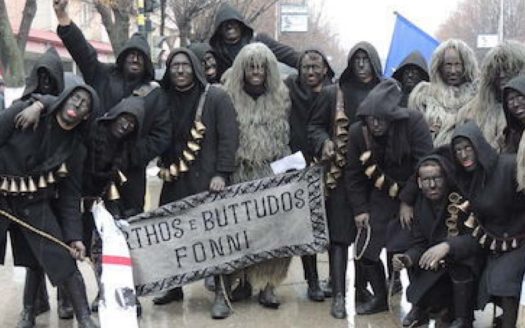
After the ritual dressing of the Mamuthones, they parade in groups of twelve, symbolising the twelve months of the year, accompanied by the Issohadores, who proceed in groups of eight.
The parade of the Mamuthones and Issohadores is a solemn ceremony, following the rhythm and order of a traditional procession.
Mamuthones advance slowly in two parallel rows, flanked by the Issohadores. Bent under the weight of their bells, they move with slow, rhythmic steps, repeatedly giving a shoulder movement to shake sa carriga and make all the bells ring. The resulting sound is one of the most distinctive features of the Mamoiada Carnival.
Issohadores, by contrast, move with greater agility. At unexpected moments, they throw their long braided reed rope, sa soha, towards the spectators, attempting to catch someone in the crowd. According to tradition, anyone who is caught must offer the Issohadores a drink in order to be released.
On Shrove Tuesday, the procession of Juvanne Martis Sero also takes place. A puppet representing Juvanne Martis Sero is carried through the streets on a cart by men dressed as “zios” and “zias”, who mourn his symbolic death with songs and sorrowful laments.
The Movements of the Mamuthones and Issohadores
The Mamuthones move differently from the Issohadores, yet their movements are perfectly synchronised. The Mamuthones move with a slow, rhythmic step, deeply rooted in tradition, but also shaped by the weight of the bells and the need to make them ring.
Each step is accompanied by a slight hop and an alternating shoulder movement, from right to left, performed in perfect unison by the entire group. This precise coordination produces a single, powerful clangour from the garrigas. After a sequence of steps, the rhythm is broken by three consecutive small jumps, creating the unmistakable sound of the Mamoiada Carnival.
The Issohadores, by contrast, move with agile, light and swift steps, while maintaining their position in the procession. From time to time, they throw sa soha, the traditional braided reed rope, towards the crowd to playfully catch someone and draw them towards the procession.
Lighter than traditional leather or hemp ropes, sa soha is difficult to control and requires considerable skill to throw accurately. For this reason, it is generally moistened before the procession, making it easier to handle.
During the procession, the Issohadores may speak and interact with the crowd, while the Mamuthones remain strictly silent throughout the entire route.
For more detailed information about the Mamoiada Carnival, please refer to this PDF by Mamoiada.org.