Tiscali: The Nuragic Village Hidden in the Mountain
A Place Suspended in Time
In the wild heart of Sardinia, between Oliena and Dorgali, Mount Tiscali hides one of the island’s most fascinating archaeological sites.
The ancient Nuragic village lies inside a vast sinkhole created by the collapse of the roof of a karst cave. Surrounded by holm oaks, junipers, ash trees, wild olive trees, mastic and fig trees, the site combines history and nature in a spectacular setting.
Tiscali may have been one of the last refuges of the late Nuragic populations during the Roman advance. Discovered in the early 20th century, it offers important evidence of the communities living in central-eastern Sardinia during the Republican period.
Tiscali and the Resistance to Rome
One historical interpretation suggests that Nuragic populations resisting Roman expansion used Tiscali as a refuge.
The Ilienses, mentioned by ancient historians, may have exploited the rugged terrain for guerrilla warfare, attacking Roman garrisons and raiding weapons and supplies before retreating into the mountains.
Its hidden and inaccessible position would have made Tiscali an ideal natural refuge, almost invisible from the outside.
Tiscali Sinkhole
Standing just over 500 metres high, Mount Tiscali separates the Supramonte of Oliena and Dorgali.
To the west lies the wild Lanaittu Valley, while to the east stretches the greener Oddoene Valley, crossed by the Flumineddu River, which has carved the spectacular Gorropu Gorge over millennia.
At the heart of the mountain lies a vast sinkhole, once a karst cave whose roof collapsed, giving rise to a lush landscape of holm oaks, junipers, ash trees, wild olive trees, mastic shrubs and fig trees.
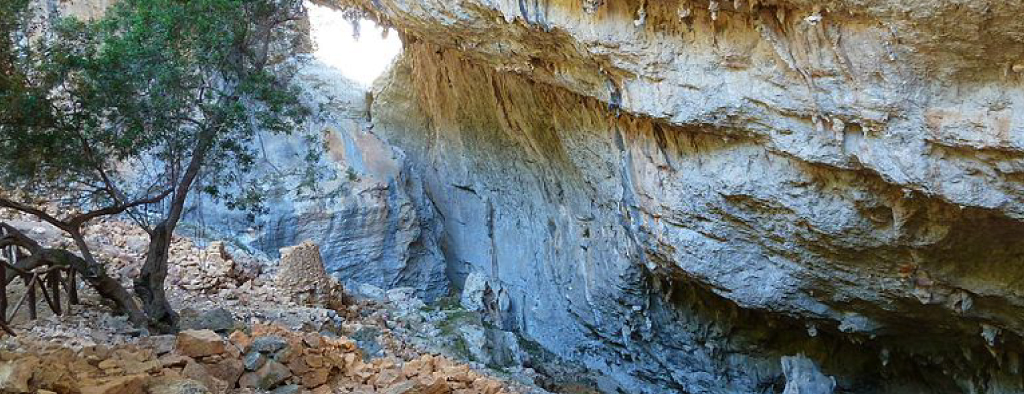
Sheltered from the sun and the elements, the sinkhole enjoys a distinctive microclimate, cool in summer and milder in winter. A vast natural opening in the rock overlooks the valley, once serving as a strategic vantage point and now offering a spectacular panorama.
Nuragic Village
The entrance to the sinkhole remains hidden until the last metres of the trail. The path then follows the edge of the cavity, overlooking a precipice of around 200 metres, before reaching the ancient settlement.
This village developed in several phases. Its earliest structures date from the Nuragic period, between the 15th and 8th centuries BC. Later modified during the Roman period, it remained in use until the Early Middle Ages.
In the northern area there are around 40 circular and oval huts, with thin walls, tholos or plant-material roofs and juniper-lintel entrances. The south-western area contains around 30 smaller square or rectangular dwellings.
The construction techniques reflect the different phases of occupation: large and medium stones laid without mortar characterize the Nuragic structures, while smaller stones and mortar were used in later buildings, probably during contact with the Roman world.
Trekking to Tiscali
Reaching Tiscali combines archaeology, nature and trekking. The trails are demanding, with steep and uneven sections. Suitable footwear and clothing, plenty of water and good physical preparation are essential; an experienced guide is recommended.
From Dorgali
Starting from the Sa Barva bridge, the trail follows spectacular rock walls overlooking Flumineddu river. It then reaches the steep Surtana steps, leading towards the summit of Mount Tiscali. Along the climb, the landscape opens onto mountains, ridges and forests.
From Oliena
The Oliena route passes through Su Gologone, the famous spring surrounded by lush vegetation, before continuing through the Lanaittu Valley towards Mount Tiscali.
A steep and uneven trail partly follows an ancient charcoal-burners’ path and takes around one and a half hours. Some sections cross a narrow ledge above the valley, requiring hikers to proceed almost in single file.
Near the summit, a narrow opening in the rock leads into the sinkhole—the only natural entrance to this ancient natural fortress.
The Supramonte and Lanaittu Valley
Tiscali is also a gateway to the spectacular Supramonte, a landscape of mountains, canyons, caves and sinkholes.
Highlights include Mount Corrasi, rising to over 1,000 metres, and the spectacular Su Suercone sinkhole.
The Lanaittu Valley contains important caves such as Sa Oche e Su Bentu and Corbeddu. These caves feature long underground passages shaped by water and decorated with stalactites and stalagmites. Corbeddu Cave has yielded traces of Homo sapiens dating back around 20,000 years.
This valley also preserves important archaeological sites, including the Nuragic village of Sa Sedda ’, Sos Carros and the sanctuary-village of Serra Orrios.
An Authentic Sardinian Experience
Tiscali brings together ancient history, wild nature, caves, archaeological remains and breath-taking landscapes.
The trek is challenging, but the experience is unique: “step by step”, the trail leads into an ancient and largely untouched Sardinia, hidden in the heart of the mountain.
Photo Credits by Roberto Mura

Archaeological museum of Dorgali
Click to visit


guides for excursions to the village of Tiscali
Click to visit